Sunday, 17 May 2020

Review: witness by Jonathan Kinsman

witness describes itself as taking the gospel back to its radical roots in a time that has whitewashed its message: a story of "a man executed by the state for saying things they didn’t want to hear" strikes an immediate attitude.

The new pamphlet from Jonathan Kinsman doesn't lie. The god word ends its dedication and then almost immediately snaps into the poems themselves. I think this word has to be dealt with first. This is a book about witnesses and it speaks through the stories of the followers of Jesus to refire the new testament. Let's just say it: this single word could stop a lot of people off buying the book and that would be a great shame.


Confession: I am a vicar's daughter. It is probably the very last thing I want to tell people. Like Theresa May and Kevin Rowland & thank goodness the Brontes. As a teenager I erased it. 

Yet this book reclaims a space I perhaps like many others gave away too willingly. The baby with the bathwater so to speak. The poems focus on the decisions, the mundane pain, the potential ignition:

so when god walks amongst you in those ramshackle streets
...whispers blessed is every last one you say
give me a gun, lord

That's the first thing to get out of the way; god is here in witness. The only weapons are words. Get used to it the poet says. Let this speak to you. And a word about the language; the poems need to be heard - I hope there are plans for a performance video. I read the poems out loud at the first reading spontaneously:

it begins outside , under the orange glow of a
lamp post while god smokes like he has been doing it
since fifteen. your ted baker suit a black stain  in
a crowd of charity shop jumpers and hand-me-down
boots. they're saying what, him?

and god says yeah, him.

There's a sense of purpose to each character's poem: both in a discreet biblical reference and their immediate currency. The witnesses tell their experience in the context of their social network: a world of pain right though to pornstar martinis, foodbanks, racism, brexit, cheap wine, transition. There's no separation in struggle. The retelling of the the loaves and the fishes was shortlisted of the Leeds poetry prize but comparison is invidious; Simon Peter is interrogated by Paxman; even the tabloid sting of Judas is a reclamation:

                                                       your tears are
hot on your face like molten silver and the barrel sits heavy on
your tongue, tastes like blood. (they asked you the price of
a kiss. you didn't know it.)


Whether this book makes you rethink the gospel or whether you think that is a place you will never go, this is a book to savour from a poet of great honesty. This 14 poem sequence repays study of its alert, suggestive narrative and bold, reclaimed space. You can buy the book here and for more follow @manykinsmen

And compliments to Burning Eye Books for their tactile emphatic cover.

Review: Genre Fluid by Dan Webber

Genre Fluid is described on its cover as a "study into labels in everyday life in the arts and the LBGTQ+ community". The pun is funny and provocative; that play on duality is specifically defended in the book and permeates its content. Dan Webber put Genre Fluid on as a show and here is his dilemma - the first of several oppositions explored - is he a comedian? or a poet? Can a funny comedian even coexist with a serious poet? It's a dilemma not unfamiliar to poet & geek. The issue centres on how we define comedians and poets - which of course is a million miles away at times from how people with these professions actually are. (Poets can't drive for example!). And how people of all types see and read us based on what they think they know.


Confession: I love the way the book is set out - PowerPoints, snippets of text conversations and use of the Courier font immediately delight me.

The book follows the show but with no hecklers; were there hecklers?  The poems are arranged in 5 sections. My very first comment written in pencil on the text is "nice bit of Courier" - I did warn you! My next comment is to immediately respond to Dan's use of rhyme - this is spoken word that needs to be heard. In the poem "Moobs" - on the subject of taps aff being A-OK compared to breast-feeding (the very word is so serious and the slang version would be tits oot well you see the problem):

Who are these anti-tit hypocrites?
Who sit on commitee and ban the titty?
More's the pity

Dan Webber is a close observer - a skill useful in both of his professions - here he describes the eponymous date in the bitter sweet poem Thief.

The patterned bag
The beaten docs
The slightly hipster woven top
The half drunk can of gin and tonic held discreetly by your side
Underneath the no drinking sign...

There are a lot of dates described in the poems seen through the prism of dating apps like Grindr. These details are read; a semaphore memorable and contradictory. Dan is a bear he thinks and like comedian and poet and emergent or mid career this label shapes how he can interact and how he can be seen. Crossing codes is dangerous and it hurts sometimes. The pain sharpens the poems but it is a strong mirror on how we relate today.

I gather that you're horny yes but I'm not feeling this
No worries, he sends
And blocks me, like I've done something wrong.

This confessional style to the poems is funny and bleak; Dan Webber is prepared to go there.


But at the end:

It's like puberty take two.
Forgive me , cause I'm still finding boundaries.

And in the end there is a kind of new definition hinted at; or a redefinition of how we can see ourselves

Wonderland
Teenage boy, applying lip gloss in a supermarket mirror
"So, then he called me queer and I was like, yeah and?"
His friends giggle like it's no big deal
Stealing from the samples, they trade eye liners
And ever so slightly, the world changes.


This book made me look forward to the next and especially to catching the show live.

Dan Webber is modest about his performance and poetry skills - this is a deft exploration of labels with a soft, disarming and wry heart. The book is published by Big White Shed with an impressive array of funding source brands on its back cover. You can buy it here and enjoy Dan on Twitter @Dan_Webber_poet


Monday, 11 May 2020

Impressions of Poetry Wales Stay at Home special issue launch

A great pleasure attending the Poetry Wales virtual launch; a full crowd with familiar faces and poets new to me, not to mention audience members joining from Shetland, Norway and perhaps even more distant places. I had wondered how an event like this would work but I was won over by the banter before we started immediately "off to milk the cat"! The atmosphere was very welcoming and, once the readings began, it was joyful too to be able to hear live poetry again.

Poetry Wales Stay at home Special Issue Launch Monday 11th May 7.30pm via Zoom


I made some notes as we went along and apologies if I misquote or misname - as everything was necessarily done by ear. Jonathan Edwards the editor at Poetry Wales was a deft and informative host who mc-ed the readings with great ease and clear structure. I have been facilitating online group calls for many years and that task in itself is harder than you might think; Jonathan made it look easy. 

The evening started with Rae Howells reading Wood thinking - we went in the order of the magazine; this was a beautiful contemplation on trees and growth born out of a railway journey view; a re-imagining that dug out "dark fists of roots...a long ear horned into the ground" coming to a resonant conclusion "the world scrabbling and wormy". I can only quote fragments here and throughout as couldn't make notes any faster.


The lack of visuals meant we missed the shape on the page of Alan Kellerman's sound poem Ornithology; an added bonus for which you need to buy Poetry Wales. Alan won me over by saying he would have to sit still to avoid his chair creaking; the sound world of Zoom didn't intervene however. The opening line "A single thrush an obsession developed into the resonant and playful; I wrote down "a franchise of finches" but I was enjoying it too much to try and write it! Neetha Kunaratnam's forensic romp through Rotten fruit and veg made an elegant paring, its humour shone darkly in current times and I noted sparked an audience member to pick out the exact line that especially delighted me "jazz apples excessive scat".


Irish poet John McAuliffe's poem Green made me think of the links course in Newcastle with my grandad  - myself exploring the gorse while he played and, in my case, hardly understanding how a golf course could be there by the sea. John described the golf lesson, with self-deprecating humour, as so unsuccessful it took him thirty years to make something of it but what a thing he made; in the poem his attention wanders and strays through the landscape "No one's beach, nun's beach - concentrate or it could be anywhere". The final line confirms an endless re-vision "Now swing, follow through, try again."


Further readings followed by Suzannah Evans who shares my love of robots but contemplated it at a whole new level - "a robot for every kind of loneliness"; and the treat of two poems from Sheenagh Pugh contrasting in her first poem Definitions of Absence, the things that aren't there "the meaning that lodges between words" and in the Aldgate Potter, the things that are - "not every epitaph or monument belongs to mastery". A  fascinating collaborative pairing of subjects from Mari Dunning and Natalie Holborrow came up next which I am glad to say is being developed into a longer sequence - the re-seeing of Rapunzel "when she shouts I drop it...a full grown woman swinging my hair like an ape...not once does she ask if it hurts" was contrasted with the darker Gothel; and the theme continued with Matthew Francis reading his mesmeric retelling of Aschenputtel again a taste of a fascinating series. Briony Collins brought proceedings to a close with great effect with her first published poem. Only Roddy Williams was missing from the line-up.

On this showing I would really recommend you download this issue FREE (wow!) or as Jonathan Edwards put it if you subscribe here and Poetry Wales can print more pages. And go to all virtual poetry! It's great.


Tuesday, 28 April 2020

Lockdown poetry book review

We ARE reviewing books - and we are open for business. Has your poetry book come out just before or during lockdown? Have you had to cancel launches and publicity. Then get in touch.

Two great titles in review coming soon:

Bron Bateman - Of memory and furniture (Freemantle Press) and Jonathan Kinsman - witness (Burning Eye Books).


Contact us by email or DM on Twitter or Instagram if you want us to review yours.

Note: we cannot get to the regular p&g postal address at the moment so you need to get in touch with us to send a physical book.


Friday, 24 April 2020

Notes on translating Follas Novas (New Leaves) 1880 Rosalía de Castro

This article first appeared in The Journal

In this, her second and last book of poems in Gallego, de Castro confounded expectations using the language to explore the intensely personal and tragic. The "new leaves" in question are no idyllic pastoral as she makes clear in the title poem:

Non follas novas: ramallo
de toxos e silvas sós…

Not new leaves: a spray
of gorse and brambles…

De Castro is well-aware of the controversy she is likely to produce. In the foreword, she confronts the problem pointing out that women can write only ‘in honey’ […pero mel sempre e nada máis que mel.]. She adds that her character and the poems’ lack of preparation (the latter a disingenuous claim) force her to add a bitter note. Her sensibility is clear in following poem.

[Life] 

I am sick and there is no cure.
A sickness born within me,
so wicked an enemy:
it will carry me to my grave.

Healers, surgeons, doctors,
in all your medicine
there is no human remedy
for this infirmity of mine.

Quit your ponderings
conscious or unaware
your science books,
they hold nothing for me.

What don’t you believe me?
There’s no doubting, doctors.
Some griefs are terminal
resistant to your cough syrup.

Are you provoked by my words?
You know I speak the truth.
Then prove it. Get to work.
Let’s see you help me, friend. My illness and suffering
are deep in my own heart.
Remove that without pity
then, I’ll have my cure.

This is the first poem that I tried seriously to translate. Its ballad structure remains but the abba rhyme scheme is dropped to bring immediacy. It is easy to lose the zest and joy in word play I find in the original. So here, for example, I have changed the last line [Despóis ¡facéme vivir!] rendered directly as ‘Then make me live’ by Aldaz, Gantt and Bromley into the version above which ties back to the first line. I have added a title. Academic opinion remains divided on de Castro titles. On her death she ordered that her daughter destroy manuscripts in her possession.


The following well-known poem however, is usually known as Lúa descolorida.

Pale moon 

Bleached moon
like pale gold
you see me
but so high
on your orbit, lift me
into dear silent light.

Star of the orphan
pale moon
you cannot help
my sad spirit.
Raise me to your master
wherever he lives.

But tell him nothing
colourless moon
for I will never
be lucky again.
If you know death,
his obscure home,

tell him to take me
body and soul
to a place where
nothing is remembered;
not in this world,
not even your lunar height.

Argentine composer Osvaldo Golijov recently set Lúa descolorida in the original Gallego to a haunting accompaniment alongside a poem by Emily Dickinson in the same song sequence. Almost contemporaries, the two share stylistic techniques in their use of form, the four line ballad verse for example, simple diction and in their use of rhyme. In life, they were very different. Dickinson (1830 – 1886) a child of privilege remained a recluse. De Castro (1837 – 1885) was born illegitimate, a ‘sacrilegious’ child of a priest and spent her early years separated from both her parents by law. (This may have not been uncommon, de Castro’s mother was also from an aristocratic family.) They could not have been aware of each other’s work.

The tragic mark left on her life may account for her often expressed feeling of despair seen in all the poems that I include here. The following poem, for example, describes a lost or hunted dove described as [soia de rama en rama], literally ‘alone in branches of branches’. The medium that could construct a home becomes a cage.

Without a nest 

Through hills and fields
trackways and on the coast
they glimpse a white dove
alone in twisted branches.

Following his poor cries
earthbound and tired
with no food,
they offer only kisses.

His feathers stained
which once were white
so very low
on shot-down wings.

Oh poor dove, once
so dear and so white.
Where did your spirit err?
And your love? Where has it gone?

De Castro’s work is more usefully seen in the context of the Celtic Revival. Her books in Gallego were the first to be written in the language, which had been proscribed, for hundreds of years. Her feminist consciousness most clearly expressed in: the final section of Follas novas [As viudas dos vivos as viudas dos mortos], ‘widows as a result of life and death’ also deserves further exploration. In her foreword she explicitly and unusually defines women as working outside and inside the home. As a result of her activism and poetry she remains well-known in Galicia and throughout Spain, her face even appearing on the 500 peseta note.


I would hope that this article would encourage more scholarship and more translations from those more able than myself. The subject matter is so stark yet with images of startling beauty but De Castro is neither constrained by form nor hesitant to use rhyme with great delicacy. This is a woman who can also produce the aural and visual bravura of lines like these:

…i é o vento que zoa
i é o frío, é a calor..

De Castro’s life ended after suffering from cancer proving the first of the poems included here prescient. She moved to Carril on the Galician coast as her end drew closer so that her final views could be those of the sea.

Alone 

They were chaotic days
reasonable afternoons
but her black sadness
remained untended.

leaving at early dawn
to return as light went,
nobody noted her
comings and goings.

One careless day
expected by no one,
she walked a path in sand
that could not be retraced.

Three days until
the sea gave her up,
the curve of the wave
here is her memorial.

To hear her poems sung in Gallego, try Rosalia De Castro by Amancio Prada. Shearsman have just published (2007) Selected poems by Michael Smith but more of Follas Novas can be found in Aldaz, Gantt and Bromley (SUNY 1991)

© Bridget Khursheed 2008 thanks to Sam Smith the editor of the Journal (once 'of Contemporary Anglo-Scandinavian Poetry') for encouraging me to write this article to accompany my translations.

Thursday, 5 March 2020

Commute

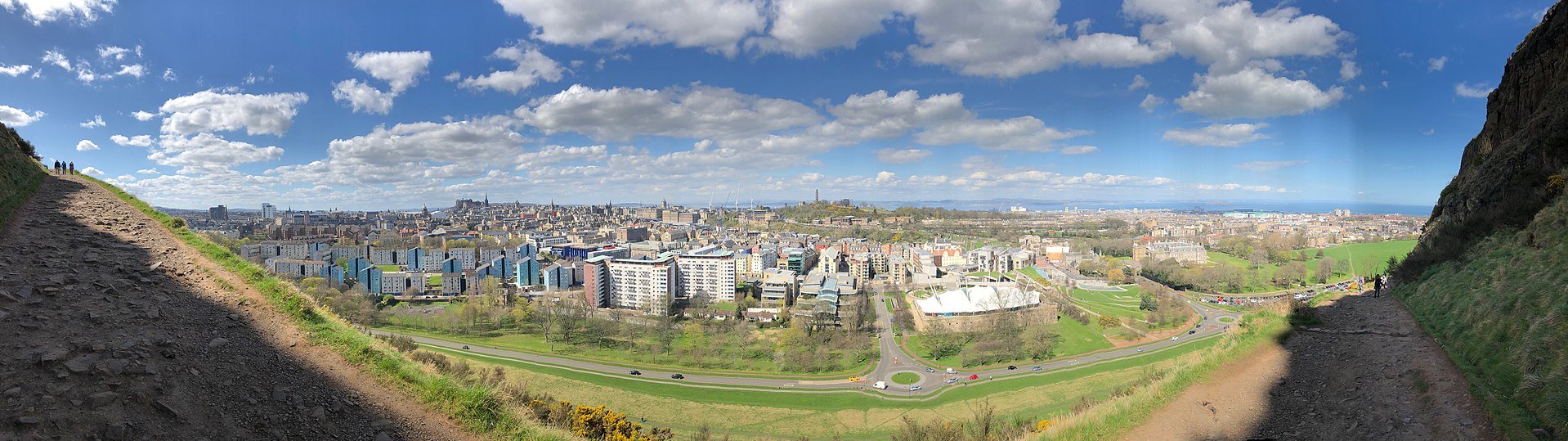
If I were to choose a spot from which the rising or setting sun could be seen to the greatest possible advantage, it would be that wild path winding around the foot of [] Salisbury Crags & marking the verge of the steep descent [] into [] Edinburgh.*

Image

Image Dave Souza


Edinburgh is a great place to walk around.


Eduardo Paolozzi foot back in Picardy Place

*No one has guessed the quote yet above - can you?

Saturday, 29 February 2020